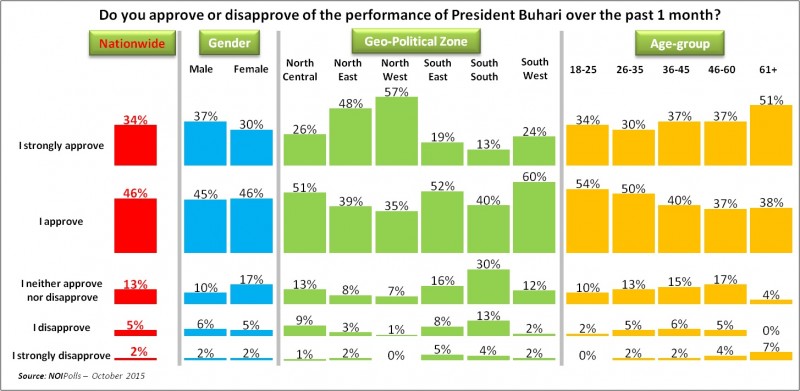
Latest governance poll results released by NOIPolls have revealed that the President’s approval rating for October 2015 stood at 80 percent.
This represents a 2-points increase from September 2015 (78 percent) and a 10-points increase from June 2015 (70 percent) when his first job performance was appraised.
Findings indicate that the increase in the President’s job performance is mostly centred on the perceived ‘improved electricity supply’ (21 percent) and ‘improved security’ (17 percent).
Analysis on the President’s performance by geo-political zones indicated that the North-West zone (92 percent: 57 percent + 35 percent) and North-East zone (87 percent: 48 percent + 39 percent) had the highest percentage of respondents who approved of the President’s job performance.
On the other hand, the South-South zone (17 percent: 13 percent + 4 percent) and South-East zone (13 percent: 8 percent + 5 percent) had the largest proportion of respondents who disapproved of the President’s job performance.
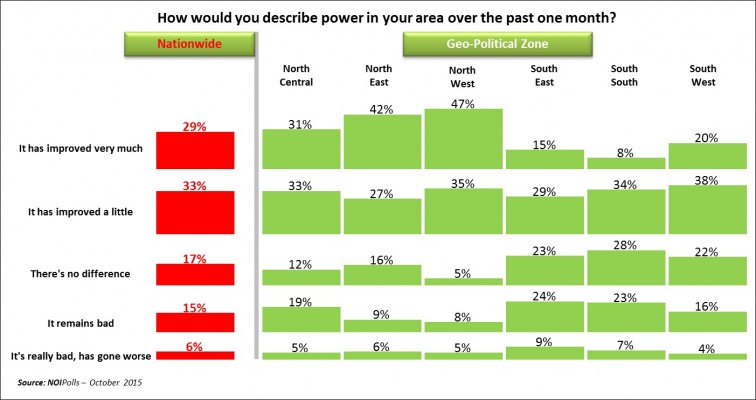
Analysis by geo-political zone revealed that the North-West (82 percent: 47 percent + 35 percent) and North-East zones (69 percent: 42 percent + 27 percent) accounted for the larger proportion of Nigerians who experienced an improvement in electricity supply, whereas the South-East (33 percent: 24 percent + 9 percent) and South-South zones (30 percent: 23 percent + 7 percent) accounted for the larger ratio of Nigerians who reported a poor state of electricity supply to their households over the past month.
In conclusion, 8 in 10 Nigerians approved the President’s job performance in October 2015. Also, the President achieved an average (3) rating in terms of his performance in National Security, Education, Healthcare, Infrastructure, Conflict Resolution, Agriculture and Food Security but he performed poorly in Job creation. Finally, majority (62 percent) of Nigerians surveyed reported that electricity supply to their household has improved over the past one month.
Note the geopolitical differences and think about it in the context of the current agitations in the South East.
the people of the region are expressing their grievances. Nigeria needs to start listening. WE really really need to talk about the Nigerian Civil War and start calling it that too. When peaceful change is impossible, violent change becomes inevitable.
 MzAgams