Theme: Power in the Boardroom (and the Senate).
Goal: To shift the narrative from “HR Issue” to “Legal Crime” and equip women to document professional abuse.
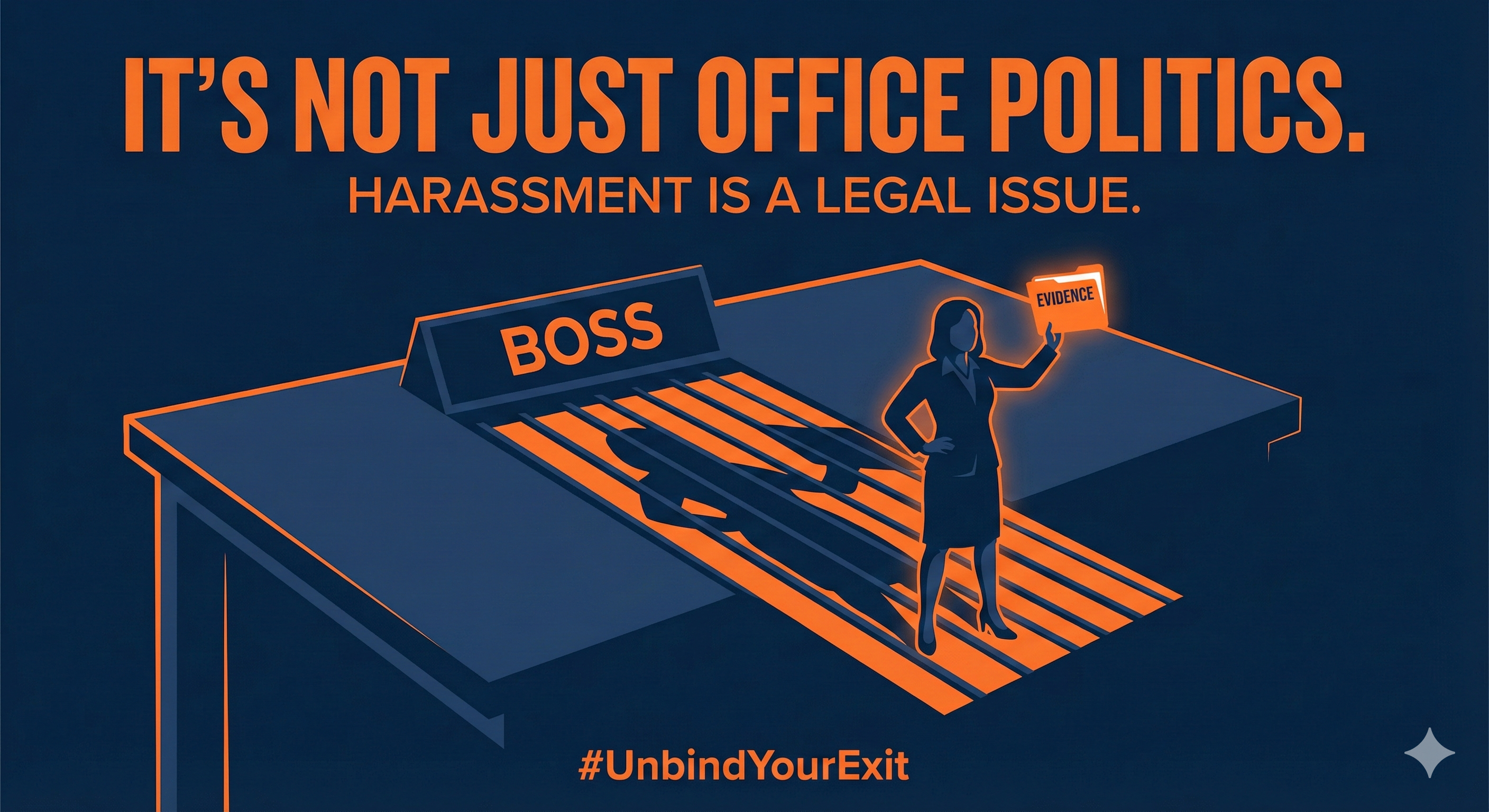
Sexual harassment isn’t just about sex. It is about power. It is about a structural system designed to remind women that their presence in the boardroom, the Senate, or the office is conditional.
We often talk about domestic violence, but what about the violence that happens between 9 AM and 5 PM?
Today, on Day 13 of #16Days, we are tackling the “open secret” of the Nigerian workplace: Sexual Harassment and the structural punishment of women who speak up. And how that has been complicated through the use of digital violence.
The “Troublemaker” Label
Natasha Akpoti-Uduaghan must be Nigeria’s most talked about sexual harassment case. A Senator of the Federal Republic sexually harassed by her ‘boss’ the Senate President. I wrote about it here.
Natasha’s case revealed Joy Nunieh had also been a victim of Akpabio’s sexual attention. For that matter so had Senator Ireti Kingibe, allegedly.
Allegedly, she passed Akpabio in the Senate Hall and he made a remark about her vagina! Read all about it here.
These are powerful, educated women in high-level political and government roles. Yet, when they challenged the status quo, the response wasn’t just professional disagreement—it was gendered attack.
- In 2020 Joy Nunieh (former NDDC MD) spoke out and faced threats, intimidation and professional sabotage. As at March 2025 she is still recovering from the personal and professional fall out.
- In 2025 Natasha Akpoti accused Akpabio of sexual harassment and faced deep-fake campaigns designed to strip her of credibility.
If this can happen to women at the top, what happens to the intern? Or the junior associate?
Meanwhile, a recent study from development Research and Projects Centre (dRPC) found that Technology-Facilitated Gender-Based Violence (TFGBV) is now a deliberate political tool, not random harassment.

My Own Experience: The System Protects Itself
I have lived this work. At Oxfam GB, I faced harassment and saw how institutions circle the wagons to protect “valuable men.” My response was to work on drafting sexual harassment policies, training teams, and building safeguarding systems.
I learned a hard truth: Laws without implementation are just words on paper.
The Legal Toolkit: It’s Not Just an “HR Issue”
Many women are gaslit into believing harassment is just an “interpersonal conflict” for HR to manage. No. In many cases, it is a crime.
- The Criminal Code Act (Sections 217–221): Criminalizes indecency and defilement.
- The VAPP Act: Explicitly criminalizes sexual harassment and intimidation (in states where domesticated).
- The Labour Act: protecting against unfair treatment.
Your Weapon is the NICN
Many women (and even generalist lawyers) do not know that the National Industrial Court of Nigeria (NICN) has specific rules explicitly designed to handle sexual harassment. You do not have to rely on vague “breach of contract” claims.
1. The Rules: Order 14 of the NICN Civil Procedure Rules 2017 This is your primary weapon. The NICN Rules explicitly define and penalize sexual harassment in a way that is broader than the Criminal Code.
- Order 14 Rule 1(a): Defines physical conduct (unwanted touching, assault, strip searches).
- Order 14 Rule 1(b) & (c): Criminalizes verbal and non-verbal forms, including “unwelcome innuendoes,” “sex-related jokes,” “indecent exposure,” and even “unwelcome whistling”.
- Order 14 Rule 1(d): Covers Quid Pro Quo harassment—where your job benefits (promotion, salary, training) are tied to sexual favors.
2. The Jurisdiction Under Section 254C (1) of the 1999 Constitution (Third Alteration), the NICN has exclusivejurisdiction over workplace disputes, including those connected to sexual harassment and discrimination.
How to File a Case at the NICN: A Step-by-Step Explainer
If internal HR policies fail (or if HR is the problem), you go to court. Here is the procedural roadmap for filing a sexual harassment claim under the NICN Rules.
Step 1: Commence by “Complaint” (Order 3 Rule 1) You generally do not start these cases with a “writ of summons.” In the Industrial Court, you file a General Form of Complaint (Form 1). This must be filed at the Registry of the Judicial Division where the harassment occurred or where the defendant resides.
Step 2: The “Frontloading” Requirement (Order 3 Rule 9) You cannot just file a complaint and “surprise” them later. You must file everything upfront. Your filing packet must include:
- Statement of Facts: A chronological story of the harassment. (Dates, times, specific words used).
- List of Witnesses: Who saw it? Who did you tell immediately after?.
- Written Statement on Oath: Your sworn witness statement (and statements from your witnesses).
- List of Documents: Copies of the emails, WhatsApp screenshots, HR complaints, and medical reports (if applicable).
Step 3: Service & Appearance Once filed, the Complaint is served on the Employer and the Harasser (Defendant). They have 14 days to enter an appearance and file their defense (Order 15 Rule 1).
Step 4: Fast Track Option (Order 25) If the harassment involves urgent issues or significant injustice, your lawyer can apply for a “Fast Track” procedure to speed up the hearing, though this is at the judge’s discretion.
Exit Feminism at Work: Document or Perish
How do you apply Exit Feminism in the office? You treat your career like a court case.
1. Keep the Receipts: Harassers rely on the “he said/she said” dynamic. Destroy that dynamic. Save every email. Screenshot the WhatsApp messages (even the ones that seem “joking”). Record the conversations if you are in a one-party consent jurisdiction or if safety is at risk.
2. Report in Writing: Verbal complaints disappear. Written complaints create a legal liability for the company. Once a company knows about harassment and fails to act, they become vicariously liable.
3. Expect Retaliation: This is the ugly part. Whistleblowing has a cost. Build your legal and social support network before you blow the whistle.
👩🏾⚖️ Lawyer Tip: The “Vicarious Liability” Trap
Here is a tip for the corporate women (and the HR managers reading this):
Harassment is a liability risk. When I advise organizations, I tell them this: If a staff member reports harassment and you bury it, you are not “saving the company’s reputation.” You are building a time bomb. For victims: Copy your personal email on all official complaints. If they lock you out of the server, you need your evidence to survive.
📊 CTA 1: ANONYMOUS SURVEY
Have you ever experienced sexual harassment in a Nigerian professional environment? Did you report it? If not, what stopped you? Fear? Shame? Lack of proof? 👉 Take the 2-minute anonymous survey: Nigerian Women’s Legal & Marital Challenges
🎓 CTA 2: WAITLIST
Do you want the “Workplace Safeguarding Checklist” to protect yourself (or your business) from liability? 👉 Join the waitlist for “Family Law in Nigeria: What Every Woman & Lawyer Must Know”: Family Law in Nigeria Course
#16DaysOfActivism #16Days #UNiTE2025 #EndGBV #NoExcuse #EXITfeminism2025 #EXITfeminism #Afrifem #UnbindYourExit #MzAgams
 MzAgams