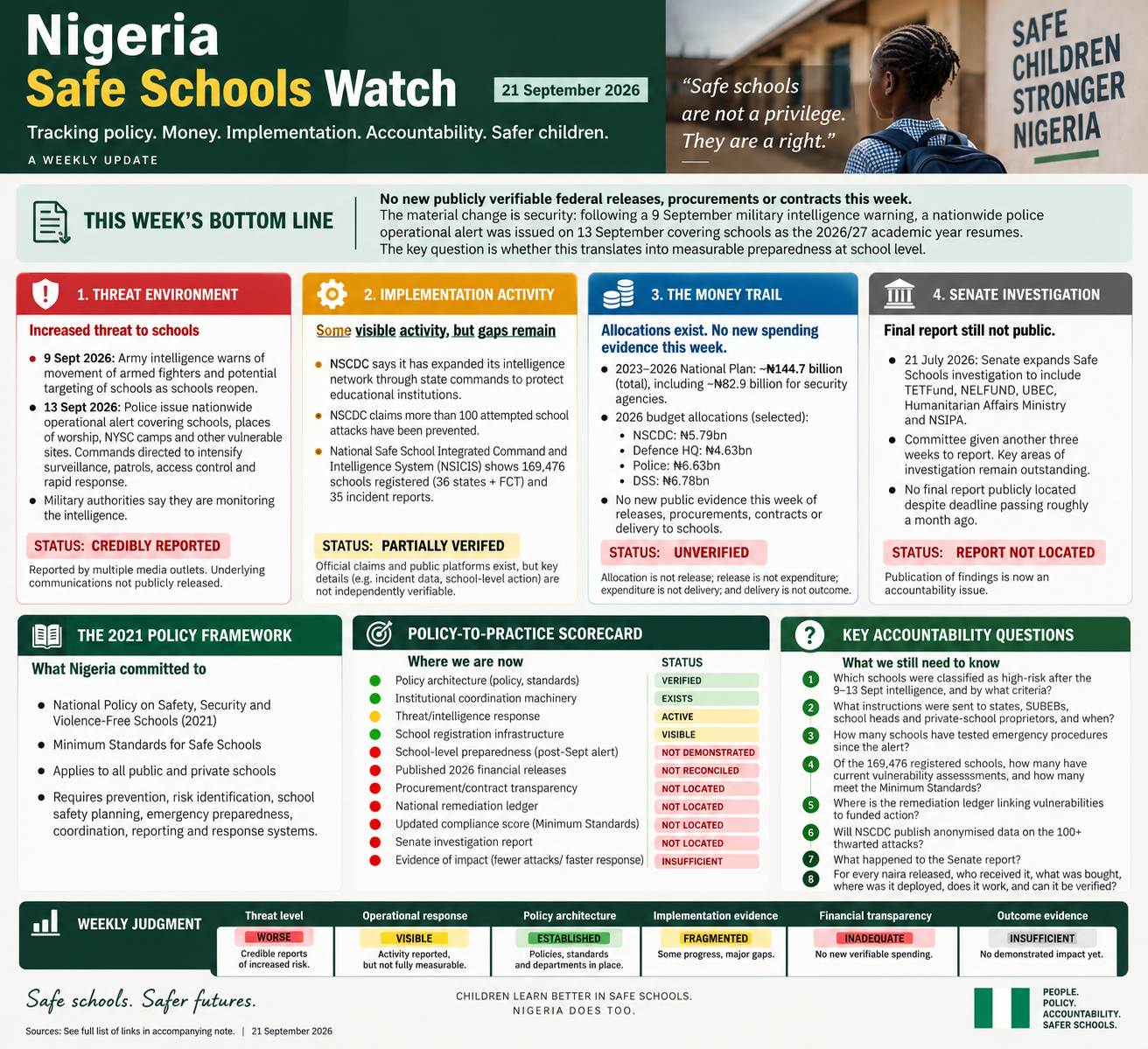
21 September 2026
THE WARNING HAS BEEN GIVEN. NOW SHOW US WHAT HAPPENED AT THE SCHOOL GATE.
Last week I experimented with the format of Safe Schools Nigeria Watch and published the weekly update on Facebook rather than here on MzAgams.
So, for anyone following the series:
Last week’s Watch: Facebook Link
The WordPress Watch resumes this week.
And something important has changed.
For several weeks, this Watch has been asking whether Nigeria’s Safe Schools architecture can move from:
policy → money → institutions → actual protection at individual schools.
This week, we have something approaching a live test.
Security agencies reportedly received intelligence warning of possible coordinated attacks on schools and other vulnerable locations as children returned for the 2026/27 academic year.
Then, on 17 September, the Police Community Relations Committee launched a nationwide Safe School programme involving 10,000 volunteers, community-based security arrangements, early-warning mechanisms and the beginning of CCTV deployment.
The question is no longer simply:
Does Nigeria have a Safe Schools system?
It is:
WHEN THE WARNING COMES, DOES THE SYSTEM WORK?
FIRST: WHAT EXACTLY IS THE THREAT?
Reporting during the week described a Nigeria Police security communication dated 13 September 2026 warning formations nationwide of intelligence concerning increased mobilisation of terrorist elements and possible coordinated attacks on schools, places of worship, NYSC camps and other vulnerable locations.
The reporting followed an earlier military intelligence warning dated 9 September, concerning movement of armed elements and possible reconnaissance of potential targets.
Let us classify this carefully.
SECURITY ALERT: 🟡 CREDIBLY REPORTED
The existence and contents of the warnings have been reported by multiple media organisations.
I have not located the underlying Police or military intelligence communications on an official public portal.
And intelligence about a possible attack is not evidence that an attack will occur.
So this Watch is not saying:
“Terrorists are going to attack Nigerian schools.”
It is saying something much more precise:
Nigeria’s security institutions reportedly received intelligence sufficiently serious to trigger preventive security measures around schools and other vulnerable locations.
That is enough to activate the accountability question.

THIS IS WHAT EARLY WARNING IS FOR
Nigeria’s 2021 National Policy on Safety, Security and Violence-Free Schools and the Minimum Standards are not merely about responding after children have been abducted.
They envisage:
- risk identification;
- prevention;
- early warning;
- preparedness;
- emergency response;
- coordination;
- and
- learning and correction.
The Federal Government has also said it is developing a comprehensive national school-safety framework involving security agencies and implementation across Nigeria’s 774 LGAs.
So this week’s warning gives us an unusually useful opportunity.
We do not have to wait for an attack and reconstruct what went wrong.
We can ask now:
What happened after the warning was received?
10,000 VOLUNTEERS. FOR HOW MANY SCHOOLS?
On 17 September, the Police Community Relations Committee (PCRC), working with the Nigeria Police Force, launched a nationwide Safe School programme involving 10,000 volunteers.
Ten thousand sounds like a lot.
But Safe Schools Nigeria Watch has learned to ask a very simple question whenever government or an implementing organisation announces a large number:
OUT OF HOW MANY?
The National Safe School Integrated Command and Intelligence System currently reports 169,476 registered schools across the 36 States and FCT.
That does not necessarily mean Nigeria has exactly 169,476 schools. It means that this is the number currently registered on the national Safe Schools platform.
But it gives us a useful sense of scale.
If 10,000 volunteers were distributed evenly across 169,476 registered schools — and there is no indication that this is the proposed deployment model — that would amount to approximately:
ONE VOLUNTEER FOR EVERY 17 REGISTERED SCHOOLS.
Or about:
0.06 VOLUNTEERS PER SCHOOL.
That calculation is illustrative only. The PCRC has said the programme will concentrate particularly on vulnerable schools in rural and remote communities, so equal distribution may neither be intended nor desirable.
Indeed, a risk-based deployment may make considerably more sense.
But that makes the missing information more important, not less.
WHAT IS THE DEPLOYMENT MODEL?
Are the 10,000 volunteers intended to be:
- stationed at individual schools?
- assigned in teams to clusters of schools?
- deployed at ward or LGA level?
- community intelligence contacts rather than physical guards?
- concentrated exclusively in schools classified as high-risk?
- additional personnel supporting existing Police, NSCDC and community security structures?
We do not yet know.
And without that information, “10,000 volunteers” tells us very little about actual school protection.
SHOW US THE DENOMINATOR
If the programme is risk-based, then publish the relevant denominator.
How many schools have been identified for coverage?
How many are classified as high-risk?
How many volunteers will be assigned to each State?
How many LGAs?
How many school clusters?
How many individual schools?
And by what criteria were those schools selected?
This need not involve publishing sensitive operational details.
Government does not need to tell potential attackers where individual security personnel stand.
But Nigerians should be able to know the scale and logic of a publicly announced national programme.
For example:
10,000 volunteers → X States → X LGAs → X school clusters → X schools protected.
That would allow the public to understand what the number actually means.
AND WHAT DOES “VOLUNTEER” MEAN?
There is another important question.
What exactly will these volunteers do?
A volunteer who provides community intelligence performs a very different function from a person stationed at a school gate.
A volunteer who observes and reports suspicious activity is different from a trained security officer expected to intervene during an armed attack.
Those distinctions matter for:
- training;
- vetting;
- supervision;
- equipment;
- communications;
- safeguarding;
- Liability; and
- response protocols.
This is particularly important because these volunteers will operate within an architecture intended to protect children.
- Who vets them?
- Who trains them?
- Who supervises them?
- What access will they have to schools and children?
- What safeguarding standards apply?
- What happens when a volunteer identifies a threat?
- Who receives the alert?
- And how quickly does somebody capable of responding arrive?
That brings us straight back to the question from Watch No. 5:
SHOW US THE RESPONSE TIME.
10,000 IS AN INPUT. IT IS NOT YET AN OUTCOME.
The announcement of 10,000 volunteers is evidence of activity.
It is not yet evidence of coverage.
It is not evidence of deployment.
It is not evidence of functionality.
And it certainly is not yet evidence that children are safer.
So the accountability chain for this programme should be:
10,000 ANNOUNCED → RECRUITED → VETTED → TRAINED → DEPLOYED → SCHOOLS COVERED → ALERTS GENERATED → RESPONSES MADE → OUTCOMES MEASURED
That is what Safe Schools Nigeria Watch will follow.
Because a large number without a denominator can create the appearance of scale without telling us the extent of actual coverage.
So before we celebrate 10,000 volunteers, there is one very simple question:
10,000 VOLUNTEERS. FOR HOW MANY SCHOOLS?
Status: 🟡 PROGRAMME ANNOUNCED / COVERAGE AND DEPLOYMENT MODEL NOT YET PUBLICLY DEMONSTRATED
So now we need the next records:
- How many have actually been recruited?
- How are they selected and vetted?
- What training do they receive?
- Who supervises them?
- What authority do they have?
- Which schools are they assigned to?
- What safeguarding rules apply when volunteers operate around children?
- How are incidents reported?
What happens when a volunteer identifies a threat?
Ten thousand volunteers should eventually produce a deployment map.
SHOW US THE DEPLOYMENT MAP.
CCTV CAMERAS: SIX CAMERAS ARE NOT A NATIONAL SYSTEM
The same programme has begun deploying CCTV cameras.
According to the PCRC, the national body has provided three cameras in the FCT, while the FCT chapter is expected to provide another three.
The stated intention is to expand surveillance across the six FCT Area Councils and subsequently extend the model nationally.
Again:
CCTV DEPLOYMENT: 🟡 COMMENCED / SCALE VERY LIMITED
This is implementation evidence.
But it is extremely early implementation evidence.
The useful questions are:
- Which schools received the cameras?
- Why were those schools selected?
- Who monitors the footage?
- Where is it stored?
- Who responds when suspicious activity is detected?
- What is the response time?
- Who maintains the equipment?
- What happens when electricity or connectivity fails?
Because a CCTV camera mounted on a wall is not itself protection.
The chain is:
Camera → Monitoring → Detection → Alert → Response → Intervention → Outcome.
So the question from Watch No. 5 remains alive:
SHOW US THE RESPONSE TIME.
169,476 SCHOOLS ARE NOW ON THE NATIONAL PLATFORM
There is another important piece of infrastructure worth watching.
The National Safe School Integrated Command and Intelligence System operated by NSCDC currently displays:
169,476 schools registered;
coverage across 36 States and the FCT;
35 incident reports;
and functions including school vulnerability scoring, incident mapping and formation assignment.
That is substantial infrastructure.
NATIONAL SCHOOL REGISTRY/INTELLIGENCE PLATFORM: 🟢 PUBLICLY VISIBLE
But registration is not protection.
The next questions are:
- How many of those 169,476 schools have actually undergone a current vulnerability assessment?
- How many are classified high risk?
- How many meet the Minimum Standards?
- How many identified deficiencies have been funded for remediation?
- How many have subsequently been reassessed?
Because the implementation chain should be:
REGISTER → ASSESS → CLASSIFY RISK → FUND → REMEDIATE → REASSESS.
Otherwise we have built a very impressive database of vulnerable schools.
AND NOW WE HAVE ANOTHER SAFE SCHOOLS ARCHITECTURE
There is something else we need to watch carefully.
Nigeria now has:
- the Federal Ministry of Education Safe Schools function;
- NSCDC;
- the National Safe Schools Response Coordination Centre;
- the National Safe School Integrated Command and Intelligence System;
- the Nigeria Police;
- Police Community Relations Committees;
- Police Safe School programmes;
- State Ministries of Education;
- State Police Commands;
- local vigilante arrangements;
- school-level structures;
- and now 10,000 proposed community volunteers.
Some States are also developing their own operational arrangements.
This may represent growing implementation.
It may also recreate a problem Government has already acknowledged:
fragmented responsibility.
So let us ask the wonderfully simple question:
A school receives information about an imminent threat. Who exactly does it call?
And then:
Who owns that incident until it is resolved?
That routing architecture should be clear to every school head in Nigeria.
THE MONEY TRAIL DID NOT MOVE THIS WEEK
This week I searched again for new publicly accessible:
- Safe Schools releases;
- procurement notices;
- contracts;
- contract awards;
- audit findings; and
- school-level expenditure records.
I did not locate a new 2026 transaction that could be followed through the complete accountability chain:
APPROPRIATION → RELEASE → RECIPIENT → PROCUREMENT → CONTRACTOR → SCHOOL → DELIVERY → FUNCTIONALITY
That does not mean no money was spent.
It means:
I CANNOT YET VERIFY IT FROM THE PUBLIC RECORD.
Those are different statements.
And I will continue making that distinction.
10,000 VOLUNTEERS ALSO CREATE A MONEY QUESTION
Volunteers may be unpaid.
But programmes are not free.
- Training costs money.
- Identification and vetting cost money.
- Uniforms, equipment, communications systems, transport and supervision cost money.
- CCTV cameras cost money.
- Installation costs money.
- Maintenance costs money.
- Monitoring costs money.
So:
Who is paying?
- The Police?
- PCRC?
- Federal Government?
- State Governments?
- Donors?
- Private companies?
- Communities?
- Parents?
The PCRC has appealed to individuals and organisations to support the programme with CCTV cameras and other resources.
That makes transparent accounting even more important.
Safe Schools financing is already difficult enough to follow.
We should not create another stream of public, private and community resources that cannot later be reconciled.
“OUR CHILDREN ARE SAFE”
At the launch, the Inspector-General of Police assured parents that children were safe in Nigerian schools.
I understand the reassurance.
But from an accountability perspective, “our children are safe” is a conclusion.
It requires evidence.
And the available national evidence still presents a difficult picture.
Recent reporting, citing a UBEC audit, says 78% of public schools lack perimeter fencing and 65% operate without security guards.
Those figures require careful treatment because infrastructure is only one component of school safety.
A fence does not automatically make a school safe.
A guard does not automatically make a school safe.
But neither can we simply declare children safe while large numbers of schools continue to lack basic protective infrastructure.
The appropriate question is:
HOW DO WE KNOW?
- What is the current national Safe Schools score?
- What percentage of schools meet the Minimum Standards?
- What percentage have functioning emergency plans?
- What percentage have safety committees?
- What percentage have tested early-warning arrangements?
- What percentage can contact a security response unit immediately?
- And what is the average response time?
Those are measurable questions.
THE “100+ ATTACKS PREVENTED” CLAIM STILL NEEDS EVIDENCE
NSCDC has repeatedly said its intelligence-led operations have prevented more than 100 attacks or threats against schools.
If that claim is substantiated, it is important.
Because this Watch is not designed only to identify failure.
If Safe Schools interventions are working, we should document that too.
But the underlying evidence has still not been publicly demonstrated in a form that allows independent assessment.
Nobody needs operational intelligence published.
Nobody needs informants identified.
Nobody needs tactical methods disclosed.
But NSCDC could publish anonymised aggregate information:
State → Threat type → Intervention → Outcome.
If more than 100 attacks have genuinely been prevented, Nigerians should know that their security architecture is producing results.
100+ ATTACKS PREVENTED: 🟡 OFFICIAL CLAIM / UNDERLYING DATA NOT PUBLICLY VERIFIED
WHERE IS THE SENATE REPORT?
Yes.
Again.
On 21 July, the Senate expanded the mandate of its Ad Hoc Committee investigating the Safe Schools Initiative and granted it another three weeks to conclude its work.
The expanded investigation was intended to examine financial flows, implementation and accountability involving Safe Schools and several Federal education and social-intervention institutions.
Committee Chairman Senator Orji Uzor Kalu told the Senate that four key areas remained incomplete and that the Committee needed another two or three weeks before returning with its report.
That period expired more than a month ago.
As at 21 September 2026:
SENATE FINAL REPORT: ❓ STILL NOT PUBLICLY LOCATED
If the investigation is incomplete:
Tell Nigerians and give us a new timeline.
If the report has been completed:
Publish it.
Operationally sensitive security information can be protected.
The financial accountability findings should not be.
AND YES. THE 48 SCHOOLS.
Seven Watches.
Same question.
The National Plan on Financing Safe Schools was intended to begin implementation in 18 high-risk States and 48 schools.
I still have not located a consolidated public implementation schedule showing those 48 schools and what each received.
ORIGINAL 48-SCHOOL IMPLEMENTATION LIST: ❓ STILL NOT LOCATED
Forty-eight schools should mean forty-eight implementation files.
For each:
Risk identified → Intervention approved → Allocation → Release → Procurement → Delivery → Functionality → Outcome.
Name the schools.
Show us the chain.
PROMISE-TO-PROOF TRACKER
21 SEPTEMBER 2026
2021 National Policy: 🟢 VERIFIED
Minimum Standards for Safe Schools: 🟢 VERIFIED
Federal school-safety institutional architecture: 🟢 VERIFIED
National school/intelligence platform: 🟢 PUBLICLY VISIBLE
169,476 schools registered on NSS-ICIS: 🟢 PLATFORM CURRENTLY REPORTS THIS FIGURE
September security warning: 🟡 CREDIBLY REPORTED / PRIMARY DOCUMENT NOT PUBLICLY LOCATED
10,000 PCRC Safe School volunteers: 🟡 ANNOUNCED / FULL DEPLOYMENT NOT YET VERIFIED
Nationwide volunteer deployment map: ❓ NOT LOCATED
PCRC CCTV programme: 🟡 EARLY IMPLEMENTATION REPORTED
National CCTV coverage: ❓ NOT DEMONSTRATED
Police early-warning/response mechanism: 🟡 OFFICIALLY DESCRIBED / FUNCTIONALITY NOT YET DEMONSTRATED
100+ school attacks/threats reportedly prevented: 🟡 OFFICIAL CLAIM / UNDERLYING DATA NOT PUBLICLY VERIFIED
2026 Safe Schools cash releases: ❓ NOT PUBLICLY RECONCILED
2026 procurement/contract trail: ❓ NOT PUBLICLY RECONCILED
National remediation ledger: ❓ NOT LOCATED
Current national Minimum Standards compliance score: ❓ NOT LOCATED
Senate final investigation report: ❓ STILL NOT PUBLICLY LOCATED
Original 48 schools: ❓ STILL NOT LOCATED
THE FIVE QUESTIONS THIS WEEK
1. WHAT HAPPENED AFTER THE WARNING?
Which schools were identified as particularly vulnerable and what preventive action was taken?
2. WHERE ARE THE 10,000 VOLUNTEERS?
How many are actually trained and deployed, where are they deployed, who supervises them and what safeguarding standards govern their work?
3. SHOW US THE RESPONSE TIME.
Nigeria now has early-warning systems, Police structures, NSCDC structures, command centres and community volunteers.
How long does it actually take from:
ALERT → RESPONSE AT THE SCHOOL?
4. SHOW US THE MONEY.
Who is financing the volunteers, CCTV, communications equipment, training and deployment?
And can that expenditure be connected to individual schools?
5. WHERE IS THE SENATE REPORT?
The deadline passed more than a month ago.
If the investigation continues, say so.
If it is finished, publish the report.
THE BOTTOM LINE
This week is different.
For months we have been looking backwards:
What was promised?
What was funded?
What was delivered?
What went wrong?
Now Nigeria has reportedly received an active warning concerning possible threats to schools.
That gives us the opportunity to watch the system before something happens.
The policy exists.
The institutions exist.
The intelligence systems exist.
The command structures exist.
A national database exists.
Police say warning and response mechanisms exist.
Ten thousand community volunteers are now being mobilised.
CCTV deployment has begun.
Good.
Now comes the test.
DOES ALL OF THAT REACH THE SCHOOL GATE?
Because the real Safe Schools chain is not:
Policy → Programme → Launch → Photograph.
It is:
POLICY → MONEY → DELIVERY → FUNCTIONALITY → SAFETY → EDUCATION CONTINUITY → LEARNING → CORRECTION
And when an actual warning arrives:
INTELLIGENCE → RISK ASSESSMENT → SCHOOL ALERT → PREVENTIVE ACTION → RESPONSE → OUTCOME → REVIEW
That is what we should now be able to observe.
Which school got what, does it work, and are the children safer?
This week, I add:
THE WARNING CAME. WHAT HAPPENED NEXT?
Sources and further reading
National Safe School Integrated Command & Intelligence System (NSS-ICIS)
PUNCH — PCRC mobilises 10,000 volunteers and begins CCTV deployment
Federal Ministry of Information — Senate expands Safe Schools investigation
Channels Television — Federal Government announces stronger Safe Schools measures
The Guardian — school-security conditions as pupils resume
Wole Soyinka Centre for Investigative Journalism — accountability for safer schools
Safe Schools Nigeria Watch is a weekly implementation-and-spending accountability series by MzAgams.
It follows Nigeria’s Safe Schools commitments from policy and financing through implementation at the school gate.
Because an announcement is not implementation.
An allocation is not a release.
A release is not expenditure.
Expenditure is not delivery.
Delivery is not functionality.
And functionality must ultimately answer one question:
Are the children safer?
Previous WordPress Watch: Safe Schools Nigeria Watch No. 6 — 7 September 2026
Last week’s Facebook-only Watch: FACEBOOK LINK
Next Watch: 28 September 2026
